
For high-performance rubber mixing, the Banbury rubber internal mixers have set standards of excellence. These sturdy machines find great demand in the production of tires, automotive components, hoses, seals, and conveyor belts. Add to it a CE certification and you’ve got a mixer that not only delivers top-tier mixing performance but also meets rigorous safety, environmental, and quality standards required in global markets.
This guide takes you inside the Banbury Rubber Internal Mixer with CE. We’ll look at its past, how it works, what CE compliance means for it, features based on performance, options for making it custom, uses in various industries, how to take care of it, and upcoming trends. Whether you are an engineering manager, production manager, R&D specialist, or purchasing professional; this guide will help you make an informed decision about your next Banbury mixer investment.
1. History & Development
This invention was created in 1916 by Fernley H. Banbury under the Farrel Corporation in the United States. It revolutionized the rubber industry by introducing high-speed internal mixing—dramatically reducing mixing time and improving compound consistency compared with open mixers.
The Banbury mixer population exploded worldwide throughout the 20th century. The proliferation of manufacturers who started making improved versions with better chamber design, drive systems, controls, and safety has benefited all users.
Since the year 2000, modern Banbury mixers have automated PLC control, energy-efficient motors, advanced safety systems, and CE standard compliances—the equipment sold in the European Economic Area (EEA) must have it.
2. Understanding CE for Industrial Mixers
2.1 What is CE in terms of Certification?
- Machinery Directive 2006/42/EC
- Low Voltage Directive 2014/35/EU
- EMC Directive 2014/30/EU
2.2 Why is CE Important for Customers Worldwide
- Allows equipment to be sold and used in Europe.
- Assures buyers that it meets international health, safety, and environmental standards.
- CE machines in other locations are considered to be of higher quality — with better design and safety aspects.
2.3 Key CE Requirements for Banbury Mixers
- Guarding: Operator is prevented from coming into contact with moving parts.
- Emergency stops: Easily accessible E-stops at the machine.
- Electrical safety: Proper earthing, insulation, and compliance with voltage/frequency norms.
- Noise & vibration: At the level of acceptable occupational exposure limits.
- Documentation: User manuals, declaration of conformity, wiring diagrams, and safety assessments.
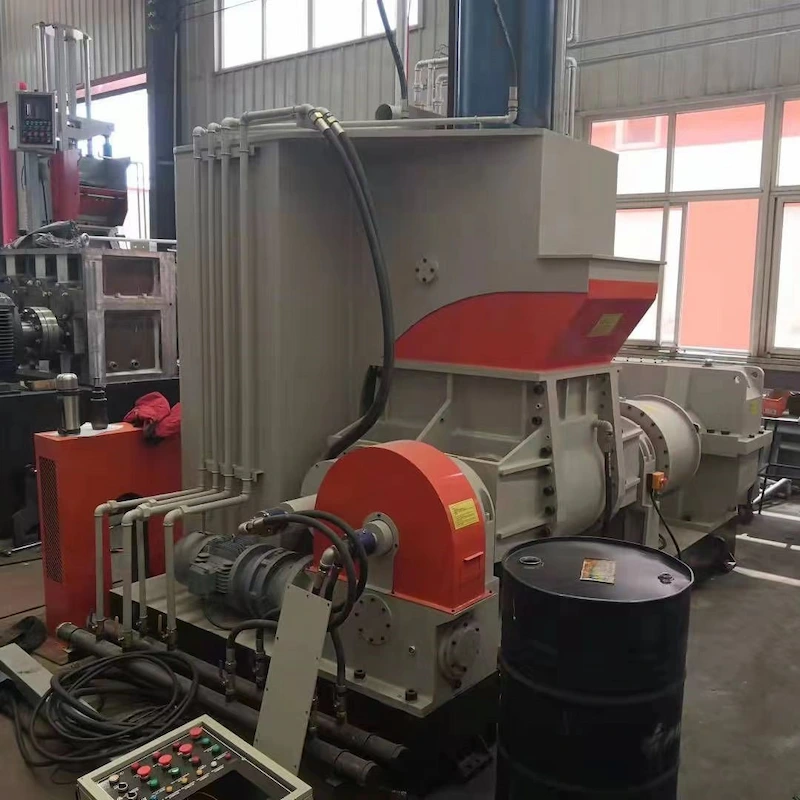
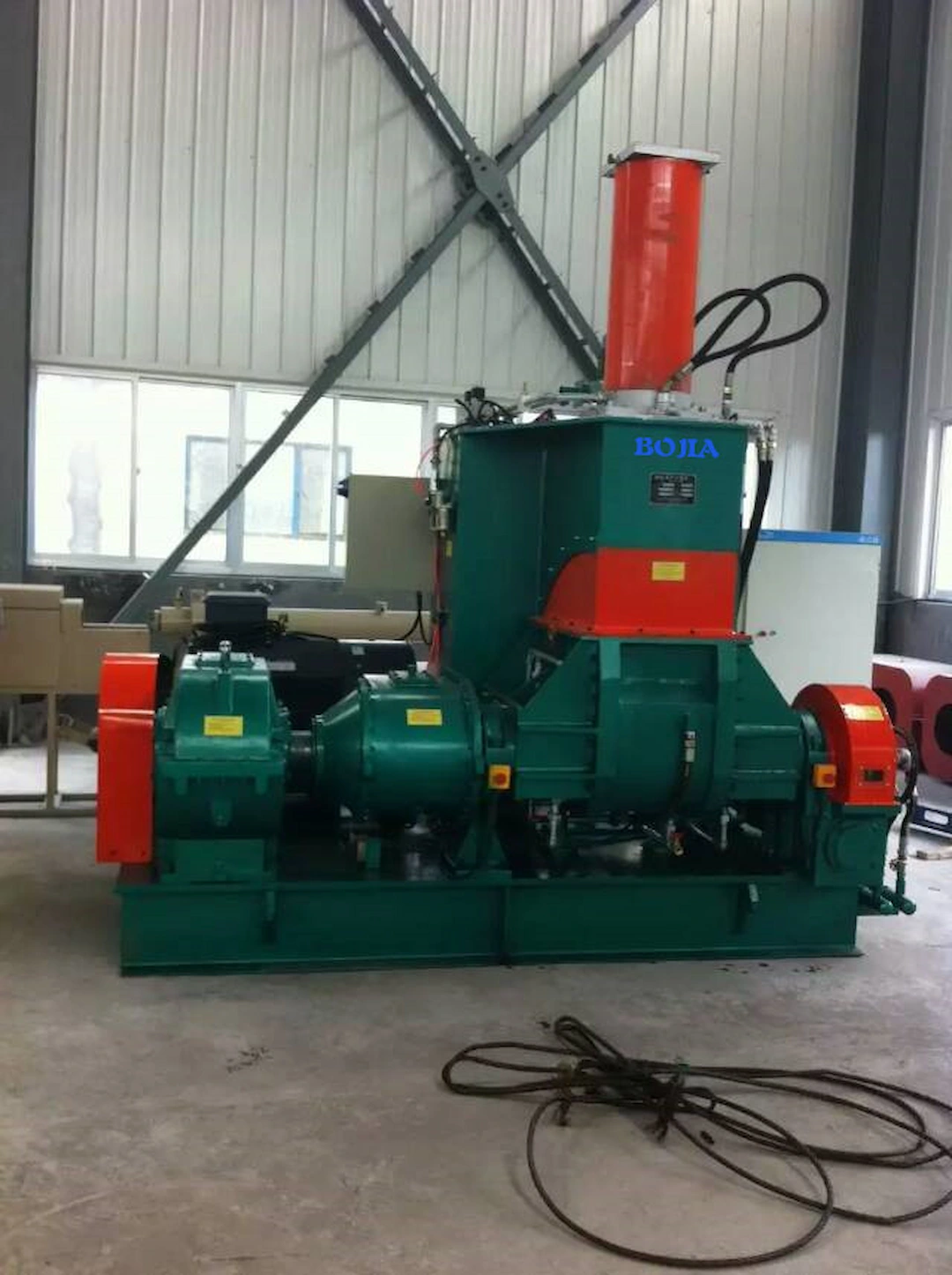
3. Core Structure & Working Principle
- Mixing Chamber: Built with a fixed and rotating tub; either straight wall or wavewall design application-dependent.
- Rotors: Mostly double-helix or Z-type, optimized for shear, friction & homogenization.
- Drive System: Powerful reduction gearbox, torque motor & coupling for steady rotation at about 40 to 80 RPM.
- Hydraulic Platen System: One platen is fixed, and the other movable for loading/unloading.
- Cabinet & Control Panel: Includes PLC system, VFD, digital metering displays.
- Cooling System: Water jackets, heat exchangers, interlocks for temperature control.
- Safety Systems: Includes guarding, emergency stops, interlocks, relief valves, rotor seizure protection.
4. Advantages of a CE-Certified Banbury Mixer
4.1 Superior Quality & Reliability
CE models undergo rigorous structural stress testing, QC checks, and FAT (Factory Acceptance Tests).
4.2 Enhanced Safety
CE marking ensures compliance with EU safety requirements including guarding, noise limits, documentation, and more.
4.3 Energy Efficiency and Environmental Compliance
Modern mixers use VFD systems, regenerative braking, and hydraulic modules for energy saving and emissions control.
4.4 Compatibility in International Markets
CE-certified mixers are accepted in Europe, Middle East, Africa, and much of Asia, enhancing market access.
5. Technical Specifications & Configurations
| Specification | Typical Range |
|---|---|
| Mixing volume | 150 kg–2000 kg |
| Rotational speed | 40–80 RPM |
| Motor power | 45–500 kW |
| Working pressure | 15–25 bar |
| Operating temperature | Up to 200°C |
| Chamber design | Wave or Laminar |
| Control options | Manual, PLC, Recipe Memory |
6. Fields & Uses
- Tires and Inner Tubes: Critical for mixing rubber with carbon black, oils, and vulcanizing agents.
- Conveyor Belts & Tubing: Requires high filler dispersion and precise temperature control.
- Rubber Molding: High uniformity needed for mechanical strength and dimensional control.
- Shoe Soles: Mixes both thermoplastics and vulcanizing elastomers safely.
- Specialty Rubber: For conductive, sealing, or adhesive compounds under CE-regulated conditions.
7. Installation, Operation & Safety Protocols
7.1 Pre-Install Requirements
- Foundation for high torque absorption
- Utilities: Voltage, cooling water, compressed air
- Space for noise padding and vibration damping
7.2 Operation Tips
- Use automatic batching and recipe control
- Monitor discharge temperature, torque, chamber pressure
- Regularly back up PLC data and settings
7.3 Safety Standards
- Emergency stop training
- Periodic safety revalidation of guards
- Check earthing and insulation resistance
8. Maintenance & Service
8.1 Daily Checks
- Monitor torque vs. temperature
- Check cooling water input/output
- Inspect gear lubrication
- Clean hopper and remove residue
8.2 Preventive Maintenance
- Sensor and PLC recalibration every 6 months
- Rotor/stator inspection annually
- Seal and O-ring replacement yearly
8.3 Troubleshooting
- Overload? Check rotor wear and parameters
- Temp issues? Check water system and jacket
- PLC alarm? Inspect interlocks and feedback
9. Cost & ROI
9.1 Initial Cost
CE models cost 30–50% more than non-CE versions due to materials, safety, and certification.
9.2 Operational Cost
Energy efficiency reduces electricity bills 10–25%; longer overhaul cycles reduce downtime.
9.3 Payback Period
Typical ROI in 2–4 years through savings on labor, energy, waste, and compliance penalties.
10. Trends & Future Outlook
- Industry 4.0: Remote monitoring, predictive maintenance
- Sustainability: Energy recovery, eco-cooling systems
- Material Evolution: Graphene, carbon nanotube blending
- Rotor Tech: 3D-optimized rotors, wear-resistant coatings
Conclusion
The Banbury Rubber Internal Mixer with CE is a quality, safe, consistent, and sustainable investment. This ensures safe operation in all parts of the world wherever there is a tire plant, hose or seal production, or specialty rubber blending because a CE-certified Banbury mixer guarantees:
- Safe operation across global standards
- Precise, repeatable mixing results
- Long-term durability with low Total Cost of Ownership
- Environmental and energy regulatory compliance
By knowing the details of design, control, certification, and service, you prepare your business to get the most value from your mixer investment—strengthening your production capabilities for today and making you ready for tomorrow’s challenges.
If your production needs require a CE-grade Banbury mixer, contacting trusted machinery suppliers with this information will lead you to the best option for your facility.