In the manufacturing world, precision is important. Whether you’re creating high-performance compounds of rubber, complex combinations of polymers, or specialized food ingredients, the fidelity of your composition is essential. Even a small deviation from the raw material ratio can lead to inconsistent quality, increased wasted material, and ultimately, a damaged reputation. This is why it’s important to invest in Automated Batching Systems, not as a luxury.
However, once you’ve decided to automate, you’re confronted with a fundamental question about engineering: how will the system specifically measure and provide you with your materials? The center of the decision is a choice between two primary technological principles: gain in weight (GIW) and loss in weight (LIW).
To an untrained eye, both approaches appear to have the same goal of measuring the weight of substances. However, for a process engineer, the distinction between them is of the same importance as the distinction between a wrench and a scalpel. They have different principles that are fundamental to their operation, and choosing the right one for your specific application is crucial to achieving the efficiency, accuracy, and flexibility that your production line needs.
Two Philosophies of Weighing
Let’s start by defining the core concept of each method.
Gain-in-Weight (GIW) Batching: The “Recipe Builder”
Imagine you are attempting to bake a cake. You place a large bowl of mixing in a kitchen’s scale and then zero it. Next, you augment the flour with 500g of flour until the scale reaches 500g. You repeat the process of taking the tare and adding sugar to it, until the scale indicates an additional 200g. You consistently repeat this process for every ingredient. This is the core of the Gain-in-Weight method of batching.
In industry, the “mixing bowl” is a central weighting device, which is mounted on a set of precise load cells. Several different feeding devices (screw feeders, vibratory feeders, etc.), each connected to a different stockpile of raw materials, they dose their respective substances into this single hopper. The system controls the amount of weight that is gained in the hopper and stops each feeder when the intended weight for that component is achieved. After all of the ingredients have been added, the entire batch of “recipe” is released from the weighing machine, this is typically done into a mixer below the machine.
Think of GIW as being: a series of steps that are cumulative, ideal for creating multiple ingredients, discrete collections.
Loss-in-Weight (LIW) Dosing: The “Flow Controller”
Now, imagine a different outcome. Large bins of flour are situated on a scale. You’ll open a drain at the bottom and let the flour pass through. By consistently measuring the total weight of the container as it is decreasing, you can precisely regulate the rate at which the flour is being released (e.g., every minute).
In an industrial system that calculates loss in weight, the entire apparatus that supplies material, the feeder (screw or vibratory), and its motor are all mounted on a dedicated set of cells that measure load. The controller is pre-programmed with a specific feed rate (target). As the feeder carries out its duties, the controller will constantly surveying the rate of weight loss in the system. It then constantly changes the feeder’s speed in order to make sure the actual weight loss rate is exactly equal to the setpoint.
Think of LIW as being: a consistent, gravimetric procedure that is ideal for precisely, continuously transferring material.
The Head-to-Head Comparison: Strengths and Weaknesses
Now that we understand the principles, let’s put them in a direct comparison across the key metrics that matter to an engineer.
Application Type: Batch vs. Continuous
This is the most fundamental distinction.
- Gain-in-Weight: Is the undisputed king of batching applications. If your process involves mixing a defined recipe of multiple components to create a discrete batch (e.g., compounding rubber, mixing paint, preparing a food premix), GIW is almost always the most logical and cost-effective choice. It excels at the “recipe” model.
- Loss-in-Weight: Is designed for continuous or semi-continuous processes. If your process involves feeding a continuous stream of material into an extruder, a continuous mixer, or onto a moving conveyor belt, LIW is the only way to achieve accurate, gravimetric flow control. It can also be used for batching by running at a high rate for a set total weight, but its true strength lies in continuous dosing.
Verdict: Choose the method that matches your core process. Mismatching them is a common and costly design error in Automated Batching Systems.
Accuracy and Control
Both systems can be highly accurate, but they achieve it in different ways.
- Gain-in-Weight: The accuracy of a GIW system depends on the resolution of the central weigh hopper’s load cells and the control of the feeding devices. To achieve both speed and precision, modern Automated Batching Systems use a two-stage feeding process. The system utilizes high-precision screw feeders and intelligent frequency control technology, allowing for a “fast feed” to quickly add the bulk of the material, followed by a “slow feed” (dribble) for the final few grams to ensure weighing accuracy. The total batch accuracy is very high.
- Loss-in-Weight: LIW systems offer exceptional accuracy in terms of rate control. The controller can make dozens of adjustments per second to the feeder speed to maintain a rock-steady flow rate. However, the system is more sensitive to external factors like vibrations or pressure changes in the hopper. Refilling the supply hopper is also a critical moment, during which the system temporarily switches to “volumetric” control, which can introduce a small, momentary inaccuracy.
Verdict: For total batch accuracy, GIW is excellent and robust. For precise, second-to-second rate control, LIW is superior.
System Complexity and Cost
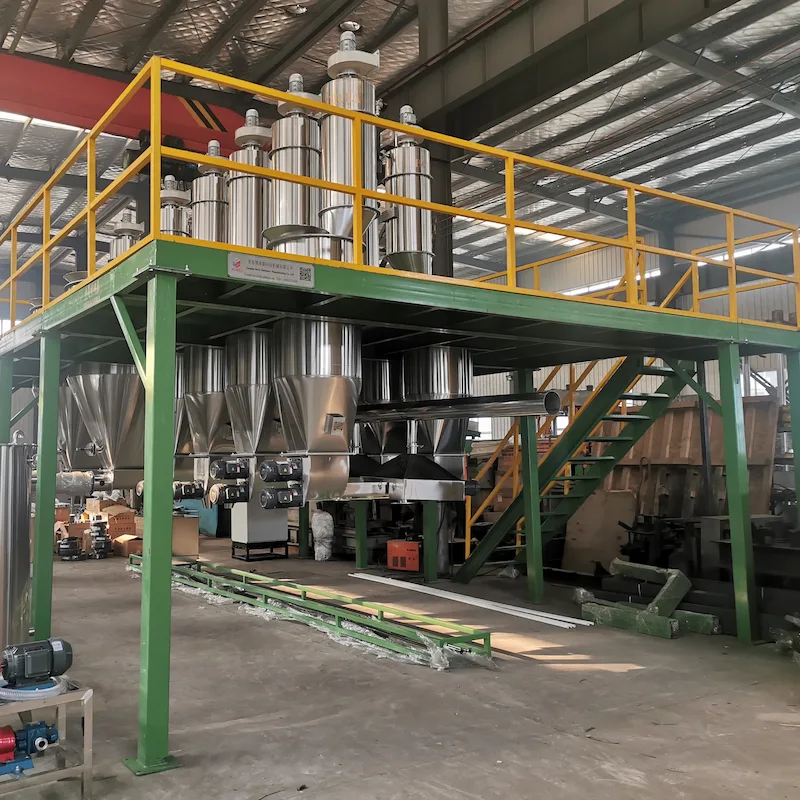
- Gain-in-Weight: GIW systems are generally simpler in both mechanical design and control logic. You have one central weighing system. This makes them more cost-effective, especially when you have a large number of ingredients. A single weigh hopper can service 5, 10, or even more ingredients. The combined structure of many modern GIW systems makes them easy to install and easy to move, offering great flexibility.
- Loss-in-Weight: LIW systems are inherently more complex. Each ingredient requires its own dedicated feeder, hopper, and weighing system. A 5-ingredient LIW system means you have five separate, complete loss-in-weight feeders, each with its own load cells and controller. This makes the initial capital investment significantly higher.
Verdict: For multi-ingredient batching, GIW offers a clear cost advantage.
Flexibility and Speed
- Gain-in-Weight: A GIW system is sequential. It adds ingredient A, then ingredient B, then ingredient C. This means the total batch time is the sum of all individual dosing times. This can be a bottleneck in very high-speed applications.
- Loss-in-Weight: In a multi-ingredient continuous process, all LIW feeders can run simultaneously, each delivering its own precise flow rate into a common stream or mixer. This allows for extremely high throughput and on-the-fly formulation changes.
Verdict: For maximum throughput and simultaneous dosing, LIW has the advantage. For most standard batch processes, the speed of a well-designed GIW system is more than sufficient.
Essential Features for Modern Automated Batching Systems
Regardless of whether you choose GIW or LIW, a modern, well-engineered system should include a suite of features designed to enhance efficiency, safety, and control. When specifying your Automated Batching Systems, these are the features you should be asking about.
1. Advanced Dust Control:
Manual batching is notoriously dusty, posing health risks to staff and creating a messy work environment. A state-of-the-art system tackles this head-on. For feeding raw materials from bulk bags, look for a driving type space bag packaging raw material feeding station. This enclosed system minimizes dust during the unloading process. Furthermore, the powder storage tank should be equipped with a single material recovery device (dust collector) to capture any fugitive dust during the unpacking of ton bags, ensuring the physical and mental health of your staff and reducing product waste.
2. Handling of Difficult Materials:
Many powders, like carbon black or certain additives, do not flow easily. They can “bridge” or “rat-hole” in the hopper, starving the feeder. Your Automated Batching Systems must be designed to handle this. Look for effective powder arch breaking mechanisms, such as powerful air hammer vibration on the hopper walls or a dedicated mixer arch breaking agitator inside the hopper to keep material flowing smoothly.
3. Intelligent and Hierarchical Control:
The “brains” of the system are just as important as the mechanics. A modern control architecture is a hierarchical distributed control system.
- Top Level (Management): This is where the control system can not only complete the automatic control of the batching and weighing process but also manage and monitor production formulas, production data, and the production process. You should have powerful data summary statistics functions and the ability to generate rich, customizable report forms. Look for a system where historical data can be stored for a long time and can also be exported from a U disk for analysis and quality audits.
- Middle Level (System Control): This is the PLC level, executing the batch logic with high efficiency, stability, and friendliness.
- Bottom Level (Equipment Control): This is the direct control of motors, valves, and sensors.
4. User-Friendliness and Security:
A complex system is useless if operators can’t use it effectively and securely.
- Simplicity: Look for features like one-key operation for standard recipes, making the system easy to operate, almost fool-like for daily production.
- Security: The system must have good confidentiality features, including password protection and a division of labor and authority refinement control. This ensures that only authorized personnel can create or modify sensitive production formulas.
- Safety: The system must include robust abnormality alarm functions. In case of a feeder jam, motor overload, or weighing error, the system should automatically alarm and display clear alarm information, guiding the operator to the problem.
The Final Verdict: Which Technology is Right for You?
Let’s distill this down into a simple decision-making framework.
Choose a Gain-in-Weight (GIW) System if:
- Your process is based on creating discrete batches of a specific recipe.
- You have multiple ingredients (4 or more) that need to be combined.
- Upfront cost is a major consideration.
- Your process does not require continuous, uninterrupted material flow.
- Example Applications: Rubber compounding, PVC mixing, paint and coatings production, food premix batching.
Choose a Loss-in-Weight (LIW) System if:
- Your process is continuous, such as feeding an extruder or a continuous mixer.
- You need to dose a small number of ingredients (1-3) at a very precise, controlled rate.
- Rate accuracy is more critical than total batch accuracy.
- High capital investment is acceptable to achieve continuous production.
- Example Applications: Plastic extrusion with additives, continuous food processing, pharmaceutical tablet manufacturing.
A Strategic Choice, Not Just a Technical One
The decision between gain and loss is one of the most important decisions you will make regarding your Automated Batching System. It’s a decision that will have an effect on your capital spending, your production efficiency, and your process flexibility for the future.
No single technology is better than another, instead, the most effective technology for your situation is the one that is most appropriate. By studying your procedure’s requirements in detail—Batch or Constant, Accuracy, and Rate Control, Cost, and Throughput are all factors that should be considered.
Ultimately, partnering with a seasoned supplier that is familiar with both technologies is essential. They can transcend the simple pitch of sales and serve as a true advisor, analyzing your unique process in order to propose a solution that is appropriate for your situation: whether it is GIW, LIW, or a hybrid of both. The correct Automated Batching Systems don’t just weight ingredients; they also provide a foundation for a consistent, high quality product.