
Introduction
A Banbury rubber internal mixer is widely used in rubber compounding to improve dispersion quality, shorten mixing cycles, and reduce energy consumption. In tire, hose, seal, and conveyor belt production, the compounding process directly affects product performance and consistency. Compared with traditional open mills, Banbury internal mixers provide a more stable and controlled mixing environment, helping manufacturers solve common issues such as uneven dispersion, long processing time, and high energy loss.
This article explains how a Banbury rubber internal mixer improves rubber compounding by looking at the internal mixing process and the real production benefits on the factory floor.
Understanding the Core: What Makes a Banbury Rubber Internal Mixer Different?
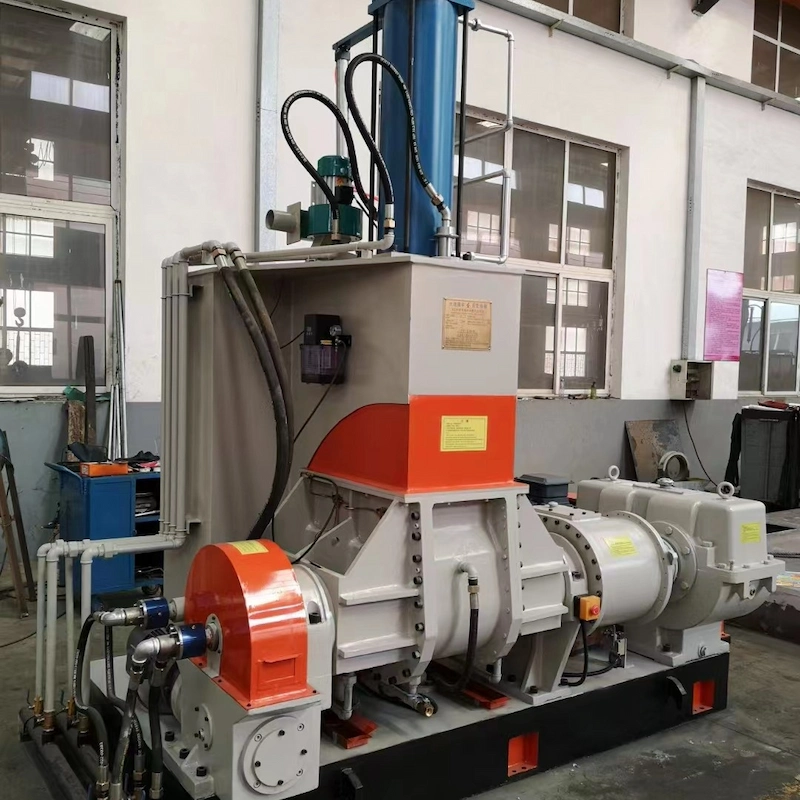
A Banbury rubber internal mixer is a closed mixing machine designed for plasticizing and compounding natural rubber, synthetic rubber, reclaimed rubber, and selected plastic materials. The Banbury design, first developed by Fernley H. Banbury in 1916, became the industry standard because it introduced a fully enclosed mixing chamber where two rotors rotate at different speeds to generate strong shear forces between the material layers.
Unlike an open two-roll mill, the performance of a Banbury mixer comes from the combination of controlled ram pressure, jacketed temperature regulation, and high-shear rotor geometry working inside a sealed chamber. The hydraulic or pneumatic ram applies consistent pressure to keep materials engaged with the rotors, while the cooling or heating jacket around the chamber allows stable temperature control during mixing. This makes it possible to maintain the material in an optimal viscosity range throughout the entire batch cycle.
Beyond dust containment, this closed design gives operators much tighter control over mixing conditions such as temperature rise, shear intensity, and dispersion uniformity—factors that are difficult to control in open mill systems and directly affect compound quality and repeatability.
Five Ways a Banbury Rubber Internal Mixer Transforms Your Compounding Process
1. Superior Dispersion Through Optimized Rotor Design
The most immediate advantage of a Banbury rubber internal mixer is its ability to deliver highly uniform dispersion. Inside the figure-eight chamber, two counter-rotating rotors operate at a fixed speed ratio (typically 1:1.1–1:1.2), generating intense shear forces that break down filler agglomerates and distribute materials evenly throughout the rubber matrix.
Unlike open mixing systems, performance here is not dependent on operator skill but on engineered geometry. Rotor design plays a critical role in determining final compound quality. Key factors include rotor wing configuration, spiral angle, and overlapping length, all of which influence how material is stretched, folded, and recombined under pressure.
The result is a more controlled internal mixing environment that directly improves:
- Filler dispersion uniformity (carbon black, silica, additives)
- Mechanical strength consistency across batches
- Reduction of weak points in finished rubber products
In practical terms, this translates into more stable curing behavior and longer service life for tires, seals, and industrial rubber components.
2. Faster Batch Cycles and Higher Production Efficiency
Compared with traditional open two-roll mills, a Banbury rubber internal mixer significantly reduces mixing time while increasing batch capacity.
A typical production comparison shows:
- Open mill: 20–40 minutes per batch
- Internal mixer: 5–10 minutes per batch (200–500 kg capacity)
This improvement is driven by the combination of enclosed high-shear mixing, controlled ram pressure, and automated PLC sequencing, which ensures each batch follows a consistent and repeatable process.
Beyond speed, the real advantage lies in production stability. Once integrated into a modern line, internal mixers reduce dependency on manual operation and allow for continuous, standardized output across shifts. This leads to fewer quality fluctuations and more predictable downstream processing performance.
3. Precise Temperature Control to Prevent Scorch
Temperature management is one of the most sensitive aspects of rubber compounding. If the compound overheats, premature vulcanization (scorch) can occur; if it is too low, dispersion efficiency drops significantly.
A Banbury rubber internal mixer solves this through a fully jacketed chamber design combined with closed-loop thermal control. Water cooling and steam heating channels regulate the entire mixing environment, while PLC systems continuously monitor and adjust real-time conditions.
Typical operating ranges fall between 70°C and 160°C, depending on formulation requirements, allowing manufacturers to fine-tune processing conditions for different rubber compounds.
This level of control ensures:
- Stable viscosity throughout the mixing cycle
- Reduced risk of premature curing
- Better adaptability for complex multi-additive formulations
Unlike open mills, where temperature is largely operator-dependent, the Banbury system provides repeatable thermal stability across every batch.
4. Energy Efficiency and Lower Operating Costs
Energy consumption is a major cost driver in rubber processing, especially in continuous production environments. A Banbury rubber internal mixer improves efficiency through optimized mechanical design and reduced cycle time.
The sealed chamber maximizes energy transfer directly into the material instead of losing it through exposure or manual handling. As a result, energy consumption can be reduced by up to 30% compared to open milling systems.
Hydraulic ram configurations further enhance efficiency by maintaining consistent pressure on the compound, shortening mixing time by 20–30% per batch. Over time, this reduction in cycle duration directly translates into lower electricity usage and improved overall plant efficiency.
In large-scale operations, these gains accumulate into substantial cost savings, particularly in tire and industrial rubber manufacturing, where continuous compounding is required.
5. Cleaner and Safer Working Environment
A key but often overlooked advantage of the Banbury rubber internal mixer is its impact on workplace safety and cleanliness.
Because the entire process takes place in a sealed chamber, exposure to carbon black dust, chemical fumes, and high-temperature surfaces is significantly reduced. This improves both environmental compliance and operator working conditions.
In modern production setups, one operator can often manage multiple mixers through centralized control systems, reducing manual handling requirements and improving overall workflow efficiency.
This shift not only lowers labor intensity but also aligns rubber processing facilities with modern occupational safety and environmental standards.
Banbury Rubber Internal Mixer vs. Open Two-Roll Mill – A Quick Comparison
To make the advantages clearer, here’s a side-by-side comparison of a modern Banbury rubber internal mixer versus a traditional open two-roll mill.
| Feature | Banbury Internal Mixer | Open Two-Roll Mill |
|---|---|---|
| Batch cycle time | 5–10 minutes | 20–40 minutes |
| Batch size range | 50–650 kg (typical) | 10–200 kg |
| Dispersion quality | Excellent, microscopic | Variable, operator-dependent |
| Dust and fume control | Enclosed – very low emissions | Open – high dust and fume |
| Energy use per kg | Baseline (reference) | ~30% higher |
| Operator intensity | Low – one operator for multiple machines | High – one operator per mill |
| Temperature control | Precise, jacketed, automated | Manual roll temperature adjustment |
| Automation potential | Full PLC control with recipes | Limited |
This table isn’t meant to suggest open mills have no place. They remain useful for small-batch specialty compounds, color changes, or laboratory work. But for any medium-to-large scale production where consistency, speed, and cost matter, the Banbury rubber internal mixer is the clear winner.
Practical User Scenarios – Where Does the Banbury Mixer Shine?
A Banbury rubber internal mixer is not a general-purpose machine—it is designed for high-intensity compounding environments where consistency, dispersion quality, and batch stability are critical. Its value becomes most obvious in demanding industrial applications where material performance directly affects end-product reliability.
Tire Manufacturing
This is the most common and demanding application for Banbury mixers. Tire production requires multiple specialized compounds, typically processed in separate mixing stages.
A standard tire plant may use:
- One internal mixer for carbon black–filled tread compounds
- Another for silica-based sidewall or belt compounds
The Banbury design is particularly effective in handling high filler loadings (up to 50–60 phr carbon black) while maintaining uniform dispersion and stable compound properties.
This ensures:
- Consistent tread wear performance
- Improved rolling resistance control
- Stable curing behavior across large production volumes
Industrial Hose and Conveyor Belt Production
For long-length industrial products, compound consistency is more important than anything else. Even small variations in mixing quality can lead to performance differences over hundreds or thousands of meters.
In these applications, the Banbury mixer ensures:
- Stable batch-to-batch formulation
- Consistent extrusion behavior
- Reliable mechanical strength across long production runs
This makes it particularly suitable for hydraulic hoses, conveyor belts, and industrial transmission products where material failure is not acceptable.
Automotive Seals and Gaskets
Automotive sealing systems require highly complex rubber formulations containing multiple additives, such as:
- Accelerators
- Antidegradants
- Processing aids
- Low-viscosity polymers
The high shear and controlled temperature environment inside a Banbury rubber internal mixer ensures that these additives are evenly distributed without localized overheating or premature curing.
This leads to:
- More stable sealing performance
- Improved heat and oil resistance
- Reduced risk of scorch during processing
Rubber Recycling and Reclaiming
Modern Banbury mixers are also increasingly used in rubber recycling applications, including blending reclaimed rubber or devulcanized material with virgin compounds.
Key advantages in this process:
- Controlled shear prevents excessive polymer degradation
- Sealed chamber reduces oxidation risk
- Stable temperature control improves material reuse quality
This makes the Banbury system suitable not only for virgin rubber processing but also for sustainable material recovery operations.
Design and Material Features That Matter
When selecting a Banbury rubber internal mixer, equipment design has a direct impact on long-term performance, maintenance cost, and production stability. Key structural elements should be evaluated carefully before investment.
Critical design considerations include:
- Chamber material: Wear-resistant alloy steel or tungsten carbide overlay for high-abrasion compounds
- Cooling system: Deep spiral jacket channels for uniform heat exchange across the chamber
- Ram system: Hydraulic ram preferred for stable pressure control and faster response
- Rotor treatment: Hard-chrome or anti-wear coating to extend service life and simplify cleaning
- Sealing system: High-quality face or ring seals to prevent leakage in long-term operation
A well-engineered Banbury rubber internal mixer is typically designed for 15–20 years of operational life, making it a long-term capital investment rather than a short-term processing tool. Proper maintenance of seals, cooling systems, and rotor surfaces is essential to maintain consistent performance throughout its lifecycle.
FAQ
1. What is the typical batch size of a Banbury rubber internal mixer?
The batch size of a Banbury rubber internal mixer depends on the model and application. Laboratory-scale machines typically handle 1–5 liters, equivalent to roughly 2–10 kg of material, while industrial production models can range from 35 to 650 liters, with a batch capacity of approximately 50–650 kg depending on compound density and formulation requirements.
2. How can I prevent scorch during rubber mixing?
Scorch prevention in a Banbury rubber internal mixer mainly relies on proper temperature and process control. Maintaining stable jacket cooling performance, using a controlled temperature rise strategy, avoiding excessive ram pressure, and optimizing the timing of accelerator addition are all essential factors. When these parameters are properly managed, the risk of premature vulcanization can be significantly reduced while maintaining consistent compound quality.
3. Is a Banbury rubber internal mixer suitable for silicone rubber compounding?
Yes, a Banbury rubber internal mixer can be used for silicone rubber compounding, but it requires strict cleaning procedures between material changes. Silicone compounds are highly sensitive to contamination, especially from sulfur-based residues, which can deactivate platinum catalysts. For this reason, thorough chamber cleaning and process isolation are necessary to ensure material purity and stable performance.
4. What maintenance does a Banbury mixer require?
Regular maintenance of a Banbury rubber internal mixer typically focuses on key mechanical and thermal systems. This includes checking dust seal conditions, ensuring stable cooling water flow and temperature, lubricating rotor bearings, verifying hydraulic ram pressure accuracy, and cleaning the feed door and chamber area. Proper maintenance not only ensures stable operation but also extends equipment service life significantly.
5. Can an older internal mixer be upgraded with modern controls?
Yes, many existing Banbury rubber internal mixers can be upgraded with modern control systems. Common retrofit options include PLC automation, hydraulic ram conversion, improved temperature monitoring systems, and enhanced safety interlocks. In many production environments, upgrading an existing machine provides a more cost-effective solution than replacing it entirely, while still achieving significant improvements in efficiency and process stability.
Putting It All Together
A Banbury rubber internal mixer plays a critical role in modern rubber compounding by improving dispersion quality, shortening mixing cycles, reducing energy consumption, and enhancing overall workplace safety. Compared with traditional open mill systems, it offers a more stable and controlled processing environment that ensures consistent compound quality across large-scale production.
Whether used in tire manufacturing, industrial hoses, conveyor belts, or automotive sealing systems, the Banbury platform provides the process reliability needed for high-performance rubber products.
Ready to Upgrade Your Rubber Compounding Line?
If you are considering a Banbury rubber internal mixer for your production facility, the most effective next step is to validate performance under real operating conditions. A qualified supplier should be able to support trial mixing with your actual formulation, provide optimized process parameters, and offer technical comparison against your current system.
Contact a professional rubber machinery manufacturer to schedule a consultation or request a batch test evaluation. This ensures the equipment selected aligns with your production goals, quality requirements, and long-term cost efficiency.