
In the world of durable, impact-resistant flooring, rubber flooring tile vulcanizing machines are essential equipment that ensure both product consistency and long-term performance. These machines are widely used across a variety of sectors, including gyms, sports centers, industrial areas, and commercial buildings. Their ability to mold, heat, and press rubber compounds into tiles makes them a cornerstone of modern rubber processing.
This article explores the core working principles, features, types, and application areas of rubber flooring tile vulcanizing machines, while offering insights into how to select the right model for your production needs.
What Is a Rubber Flooring Tile Vulcanizing Machine?
A rubber flooring tile vulcanizing machine is a specialized press used to shape and cure rubber tiles under heat and pressure. It ensures that the raw rubber compound is transformed into a strong, durable, and elastic tile with desirable physical and mechanical properties. The process, called vulcanization, chemically links polymer chains in the rubber, improving resistance to heat, wear, and deformation.
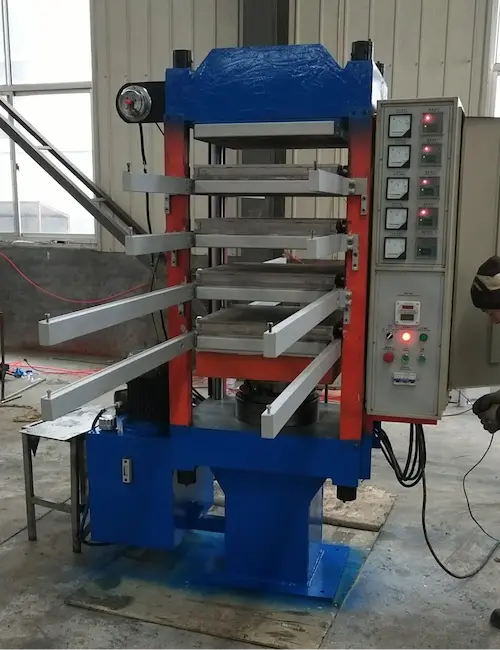
These machines often include a hydraulic or mechanical press, precision temperature controls, and multi-daylight platens for mass production of rubber floor tiles.
Vulcanization: The Science Behind the Machine
The vulcanization process dates back to Charles Goodyear’s invention in the 19th century. In modern tile production, vulcanization involves:
Applying heat (typically between 140°C–180°C)
Applying uniform pressure
Holding for a specific time (10–30 minutes depending on tile thickness)
This converts the thermoplastic rubber into a thermoset material, giving the tile its final strength, elasticity, and shape.
Key Components of a Rubber Flooring Tile Vulcanizing Machine
Let’s break down the major parts of a standard rubber tile vulcanizing press:
| Component | Description |
|---|---|
| Hydraulic System | Generates the necessary pressing force to compress the rubber in molds. |
| Heated Platens | Large, flat plates that are electrically or steam heated to cure the rubber. |
| Control Panel | Digital interface to control temperature, time, and pressure. |
| Daylight/Mold Cavity | The space where molds are placed. Multi-daylight machines can press several molds at once. |
| Safety Devices | Includes emergency stops, limit switches, and thermal protection. |
Types of Rubber Flooring Tile Vulcanizing Machines
There are several variations of these machines depending on capacity, mold size, and production style:
1. Single-Daylight Vulcanizing Press
Ideal for small workshops or prototype development. Offers precision control but lower output.
2. Multi-Daylight Vulcanizing Press
Used in industrial production lines. Multiple layers allow for simultaneous vulcanization of many tiles, improving efficiency.
3. Column Type Vulcanizing Machine
A vertical press with strong side columns, offering high-pressure capabilities. Common in heavy-duty applications.
4. Frame Type Vulcanizing Press
A closed-frame structure that enhances structural rigidity. Suitable for large-format rubber flooring tiles.
Technical Specifications to Consider
When choosing a rubber flooring tile vulcanizing machine, manufacturers and buyers should evaluate the following specs:
| Specification | Typical Range |
|---|---|
| Plate Size | 500x500mm to 1200x1200mm |
| Number of Daylights | 1 to 4 (or more for high-volume) |
| Max Working Pressure | 1–3 MPa |
| Heating Method | Electric, Steam, Oil Heating |
| Temperature Control Accuracy | ±1°C |
| Cycle Time | 10–25 minutes |
Applications of Rubber Flooring Tile Vulcanizing Machines
Rubber flooring is popular in environments that demand durability, slip-resistance, and ease of maintenance. Vulcanizing machines help produce rubber tiles for:
Gym Flooring
Playgrounds
Industrial Flooring
Animal Stables
Garage Mats
Soundproof Rooms
Hospital Walkways
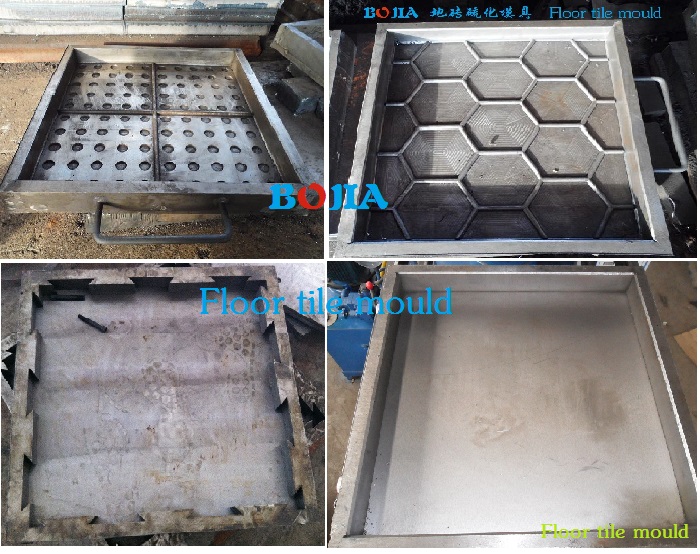
Each application requires specific hardness, density, and surface textures, which can be customized using interchangeable molds.
Benefits of Using Vulcanized Rubber Tiles
By using a rubber flooring tile vulcanizing machine, manufacturers ensure:
Dimensional Accuracy: Each tile conforms to preset thickness and width.
Enhanced Durability: Vulcanized tiles resist cracking and deformation.
Eco-Friendly Options: Many systems are compatible with recycled crumb rubber.
Customization: Different patterns, colors, and textures can be achieved with custom molds.
How to Choose the Right Rubber Flooring Tile Vulcanizing Machine
Here’s a quick checklist for selecting the right equipment:
| Criteria | Considerations |
|---|---|
| Production Capacity | How many tiles per hour do you need? |
| Tile Size | Are you making small tiles or large-format sheets? |
| Power Supply | Ensure compatibility with your facility’s power grid. |
| Automation Level | Manual, semi-automatic, or fully automatic? |
| After-Sales Support | Does the supplier offer training, spare parts, and maintenance? |
Common Challenges and Solutions
| Challenge | Solution |
|---|---|
| Uneven Temperature Distribution | Use machines with PID-controlled heaters. |
| Inconsistent Pressure | Regularly calibrate the hydraulic system. |
| Long Downtime | Choose modular machines with easy mold changes. |
| Tile Defects (bubbles, warping) | Optimize curing time and mold sealing. |
Future Trends in Rubber Tile Vulcanizing Technology
With growing demand for eco-conscious products and smart manufacturing, expect these trends:
Integration of IoT for real-time monitoring
Energy-efficient heating systems
Mold robotics for faster mold changes
Automated unloading systems
Use of biodegradable rubber alternatives
Leading Manufacturers and Global Supply Chain
Some globally known manufacturers of rubber flooring tile vulcanizing machines include:
HF Mixing Group (Germany)
Qingdao Xincheng Yiming Rubber Machinery (China)
Santosh Rubber Machinery (India)
Barwell Global Ltd (UK)
Most offer OEM services, mold customization, and CE-certified equipment for export.
Maintenance Tips
To prolong the machine’s life and ensure high-quality output:
Clean platens after each cycle
Lubricate hydraulic components weekly
Check electrical wiring monthly
Perform annual calibration and software updates
Store molds in a dry, rust-free environment
The rubber flooring tile vulcanizing machine is a vital tool in transforming raw rubber into resilient, attractive, and customizable tiles. Whether you’re a startup in rubber recycling or a large flooring manufacturer, choosing the right vulcanizing machine impacts everything from product quality to profitability. With proper usage, maintenance, and innovation, these machines are poised to remain a key component in sustainable and modern flooring solutions.