
In rubber manufacturing, efficiency does not begin at mixing or molding. It begins at preparation. Before any compound is blended, extruded, calendared, or vulcanized, compressed rubber bales must be cut into manageable, uniform pieces. That first mechanical action sets the tempo for everything that follows.
A rubber bale hydraulic cutting machine may look simple: a frame, a blade, and a hydraulic cylinder. Yet in practice, it is a force-management system. It converts electrical energy into controlled mechanical pressure, applies it through a blade geometry optimized for elastomer resistance, and determines whether your downstream process runs smoothly or struggles with feeding inconsistency.
Choosing the right machine is not a matter of selecting the highest tonnage available. It requires aligning material properties, production rhythm, structural durability, safety systems, and long-term cost control. When the selection is correct, the cutting stage disappears into the background of production. When it is wrong, it becomes a bottleneck.
The Strategic Role of Bale Cutting in Rubber Processing
Rubber is not a passive material. It is elastic, resilient, and resistant to deformation. Compressed into dense bales for transport, it stores internal stress. When force is applied, it resists, rebounds, and redistributes pressure unevenly.
This means cutting rubber is fundamentally different from cutting rigid materials such as metal or wood. The blade must overcome both compression resistance and elastic recovery. If force is insufficient or poorly controlled, the bale deforms rather than slices. The result is tearing instead of clean separation.
In industrial plants, cutting quality affects:
Feeding stability into internal mixers
Batch weight accuracy
Mixing time consistency
Energy consumption in downstream processes
When cut size varies, mixing torque fluctuates. When feeding is inconsistent, cycle time increases. Over thousands of cycles, small inefficiencies compound into measurable production loss.
A well-selected hydraulic cutting machine stabilizes the beginning of the value chain.
The Mechanical and Hydraulic Architecture
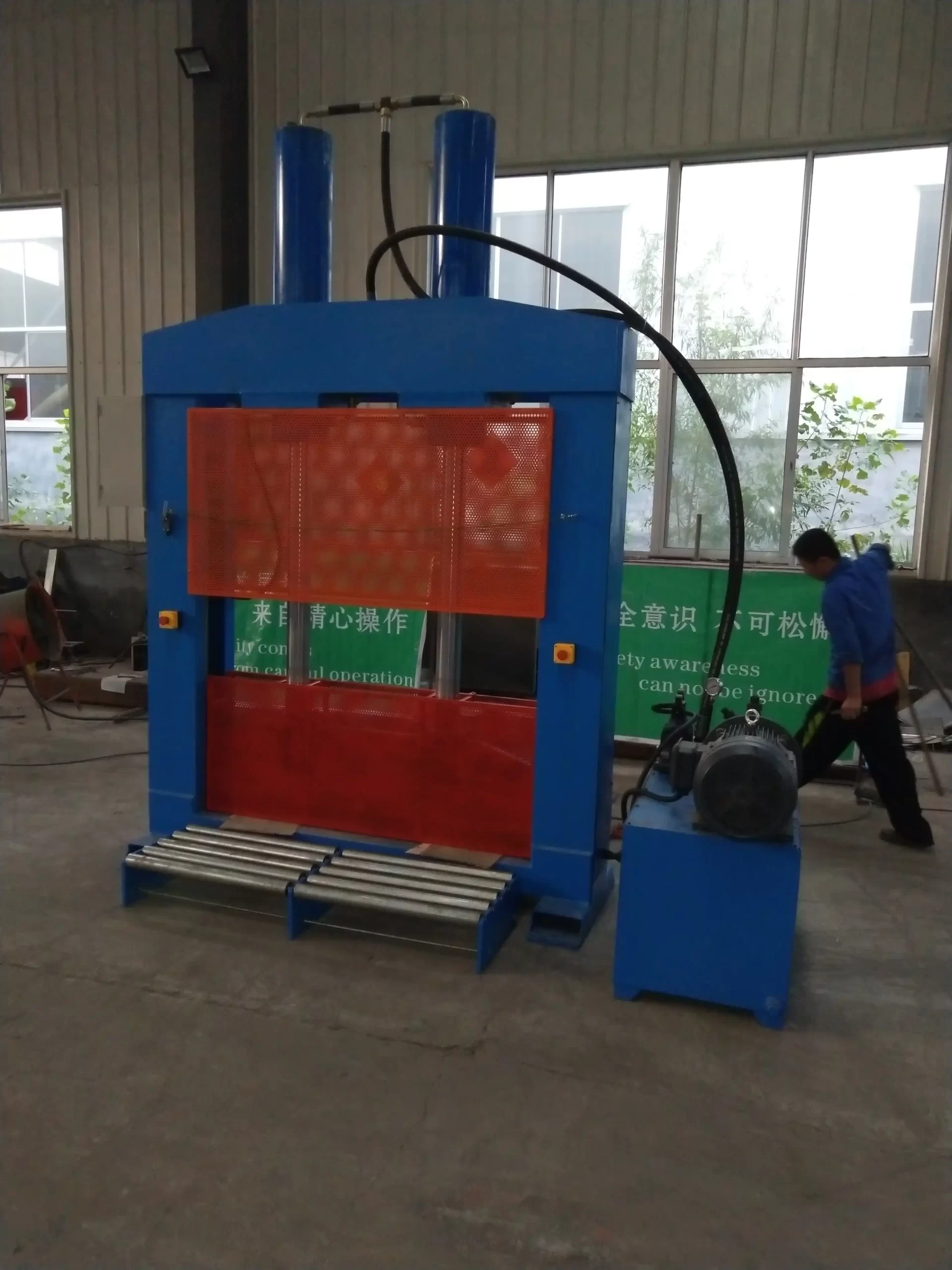
At its core, a rubber bale hydraulic cutting machine consists of a structural frame, hydraulic power unit, cutting blade assembly, and control system. These components operate as a unified pressure-delivery mechanism.
The hydraulic power unit generates oil pressure using a motor-driven pump. This pressurized oil drives a cylinder that pushes the blade through the rubber bale. Because hydraulic systems allow high force at controlled speed, they are ideal for materials with variable resistance.
Two primary structural configurations exist: vertical cutting machines and horizontal cutting machines.
Vertical systems use gravity-assisted blade motion. They typically occupy less floor space and are suitable for moderate production volumes.
Horizontal systems apply force laterally. They often allow easier automation and integration with conveyors, making them better suited for higher throughput lines.
The difference is not only spatial; it is operational. Horizontal systems often provide smoother feeding integration, while vertical systems may be simpler to maintain.
Evaluating Cutting Force and Material Compatibility
Cutting force, usually expressed in tons, is the most visible specification. However, tonnage alone does not guarantee performance.
The required force depends on several interacting variables:
Rubber type (natural rubber, SBR, EPDM, reclaimed rubber)
Bale density and compression ratio
Ambient temperature
Desired cut dimensions
Blade geometry
Natural rubber at low temperatures can become significantly harder. Reclaimed rubber may contain fillers that increase resistance. EPDM, with its saturated polymer backbone, often requires higher cutting pressure than softer compounds.
If tonnage is underestimated, incomplete cuts occur. Operators may attempt repeated strokes, increasing wear and slowing production. If excessively oversized, the machine consumes more energy and increases structural stress without improving productivity.
The optimal approach is to match force capacity to your most demanding material scenario, not your average case.
Blade Design and Metallurgical Considerations
The blade is not simply a sharpened steel plate. It is a stress concentration tool. Its geometry determines how force is distributed across the bale surface.
A well-designed blade typically features:
High-strength alloy steel composition
Heat-treated hardness for edge retention
Optimized thickness to prevent deflection
Angled edge geometry to reduce peak resistance
An angled blade reduces instantaneous load by distributing force progressively across the cutting surface. This lowers hydraulic shock and extends cylinder life.
Blade wear is inevitable. The key is predictability. Machines that allow quick blade removal and replacement reduce downtime significantly. In high-volume plants, blade maintenance planning should be integrated into preventive maintenance schedules.
A poorly selected blade material leads to micro-chipping, uneven cuts, and higher energy consumption due to increased friction.
Structural Rigidity and Frame Engineering
Hydraulic force can exceed dozens of tons. Without sufficient structural reinforcement, frames deform gradually over time.
Even slight frame deflection affects blade alignment. Misalignment increases friction and uneven load distribution, accelerating wear on both blade and cylinder seals.
Structural evaluation should include:
Steel plate thickness
Reinforcement rib placement
Weld quality
Surface stress distribution design
Finite element analysis is increasingly used by advanced manufacturers to simulate stress behavior under maximum load. Machines designed with such engineering analysis tend to demonstrate longer service life and more stable operation.
Durability is not visible on day one. It reveals itself after several years of continuous cycles.
Hydraulic System Stability and Energy Efficiency
The hydraulic system is the heart of the machine. Its stability determines whether force delivery is smooth or erratic.
Key engineering considerations include:
Pump type (fixed displacement or variable displacement)
Pressure control valves
Oil filtration level
Cooling system design
Leakage prevention measures
Variable displacement pumps adjust flow according to load demand. This improves energy efficiency and reduces unnecessary motor load during idle periods.
Oil contamination is one of the primary causes of hydraulic failure. Machines equipped with high-grade filtration systems experience fewer valve malfunctions and longer service intervals.
Hydraulic shock can damage seals and shorten cylinder life. Proper pressure ramp control prevents sudden force spikes.
In long-term operation, hydraulic quality directly correlates with maintenance cost.
Automation Level and Control Integration
Automation determines how well the cutting machine integrates into modern production environments.
Manual systems require operators to position bales and activate dual-hand controls for safety. These systems are cost-effective but labor-intensive.
Semi-automatic systems may include powered bale positioning and programmable stroke control.
Fully automatic systems integrate with conveyor lines and upstream storage systems. They can be controlled via PLC interfaces and synchronized with mixing schedules.
Automation improves consistency and reduces human error. However, complexity increases installation and maintenance requirements.
The decision should reflect production scale and workforce structure rather than technological ambition alone.
Safety Engineering and Operational Protection
Industrial cutting involves substantial force. Safety mechanisms must be integrated, not added as afterthoughts.
Critical safety features typically include:
Dual-hand operation to prevent accidental activation
Emergency stop circuits
Mechanical blade guards
Pressure relief valves
Electrical interlock systems
Advanced systems may incorporate light curtains or sensor-based shutdowns.
Safety design affects insurance compliance and worker confidence. A safe machine improves morale and reduces downtime associated with incidents.
Efficiency and safety are not opposing forces. Properly engineered systems achieve both simultaneously.
Installation Planning and Spatial Efficiency
Selecting the right machine also involves environmental evaluation.
Floor load-bearing capacity must support both machine weight and operational force transfer. Hydraulic oil tanks require proper ventilation. Maintenance access zones must be reserved around the machine.
In automated environments, material flow direction matters. Poor layout planning can create unnecessary material handling loops, increasing forklift traffic and accident risk.
Efficient plants design cutting stations as integral nodes within a linear process flow.
Maintenance Planning and Service Life Optimization
No cutting machine operates indefinitely without service. The difference lies in how predictable maintenance requirements are.
An effective preventive maintenance program typically includes:
Regular blade inspection and sharpening
Hydraulic oil condition monitoring
Seal replacement scheduling
Bolt torque verification
Electrical system inspection
Predictable maintenance reduces emergency shutdowns. Machines designed for easy component access significantly reduce service time.
The true test of a machine is not how it performs in the first month, but how stable it remains after millions of cutting cycles.
Comparing Machine Configurations
Below is a simplified comparison of common rubber bale cutting machine types.
| Jellemző | Vertical Type | Horizontal Type | Fully Automatic System |
|---|---|---|---|
| Floor Space | Compact | Mérsékelt | Larger |
| Automatizálási szint | Basic to Medium | Medium | Magas |
| Labor Requirement | Manual loading | Assisted loading | Minimal |
| Throughput Capacity | Mérsékelt | Magas | Very High |
| Investment Cost | Alsó | Mid-range | Highest |
| Integration Flexibility | Limited | Good | Excellent |
This table provides directional guidance rather than absolute conclusions. Production context determines suitability.
Three Critical Decision Dimensions
Before making a final selection, decision-makers should evaluate three core dimensions.
Production throughput requirements and future expansion plans
Material characteristics under worst-case conditions
Total cost of ownership over expected service life
These three factors intersect. A machine that meets today’s demand but lacks expansion capacity may require premature replacement. Conversely, oversizing without clear growth plans ties up capital unnecessarily.
Engineering decisions are rarely about maximum capability. They are about optimal alignment.
Economic Analysis: Looking Beyond Purchase Price
Capital expenditure is only one part of the equation. Operating expenditure often exceeds initial cost over the machine’s lifetime.
Key cost factors include:
Electricity consumption
Blade maintenance frequency
Hydraulic oil replacement
Spare parts availability
Downtime cost per hour
Labor allocation
Calculating cost per ton of processed rubber provides a realistic performance metric. A slightly more expensive machine with lower energy use and reduced downtime may deliver superior return on investment.
Long-term thinking prevents short-term purchasing errors.
Future Trends in Rubber Bale Cutting Technology
Industrial equipment continues to evolve. Several emerging directions are shaping modern cutting machines.
Servo-hydraulic systems improve precision and energy efficiency. Intelligent pressure monitoring allows predictive maintenance. Integrated weighing systems enhance batching accuracy. Remote diagnostics support faster service response.
These developments align with broader smart manufacturing initiatives.
However, technology should serve operational needs. Advanced features are valuable only when they solve real production challenges.
Efficiency as a System Outcome
Choosing the right rubber bale hydraulic cutting machine is ultimately a systems engineering decision. It requires aligning force capacity, material behavior, structural durability, hydraulic stability, automation level, and economic planning.
When these variables are balanced, cutting becomes invisible. Production flows smoothly. Maintenance becomes predictable. Energy consumption stabilizes.
Efficiency is not created by a single specification. It emerges from the interaction of well-matched components within a thoughtful design framework.
In rubber manufacturing, the first cut determines the rhythm of the process. Selecting the right machine ensures that rhythm remains steady, controlled, and profitable for years to come.