
For manufacturers facing these pressures, the automatic rubber flooring tile vulcanizing machine often becomes the point where production stability replaces manual uncertainty.Rubber flooring production rarely begins with automation in mind. Many manufacturers start with manual or semi-automatic vulcanizing methods because they appear flexible, affordable, and sufficient for early-stage output. At small volumes, these systems work well enough. Operators control heat and pressure directly, molds are handled by hand, and production schedules remain manageable.
The shift toward automatic vulcanizing does not happen overnight. It emerges gradually, often triggered by a series of operational pressures that are easy to overlook at first. Orders become larger, delivery timelines tighten, and customers start paying closer attention to consistency between batches. What once felt like a production advantage—manual control and flexibility—slowly turns into a bottleneck.
Automatic vulcanizing enters the picture not as a technological upgrade, but as a response to accumulated strain inside the production process. The moment rubber flooring production needs automatic vulcanizing is not defined by ambition alone. It is defined by limits.
The Early Signs of Production Strain
Every rubber flooring facility experiences a phase where output increases faster than systems evolve. During this phase, production may still appear stable from the outside, but internal pressure begins to rise. Small inefficiencies that once went unnoticed start to compound.
At this stage, production teams often notice subtle but persistent issues. Cycle times vary more than expected. Finished tiles from different shifts show slight visual or dimensional differences. Operators rely heavily on experience rather than process control, and quality checks become more frequent.
These early signs are not failures. They are indicators that production volume and process design are drifting out of alignment. Rubber flooring manufacturing is especially sensitive to this imbalance because vulcanizing determines not only surface finish, but also density, elasticity, and long-term durability.
Manual vulcanizing systems depend on human judgment for temperature timing, pressure balance, and mold handling. As order volume grows, that dependence becomes increasingly risky. What works reliably at low throughput becomes fragile when scaled.
At this point, manufacturers often attempt to compensate by adding labor, extending shifts, or tightening inspection standards. These adjustments delay the problem, but they do not resolve it.
Why Manual Vulcanizing Stops Scaling Effectively
Manual and semi-automatic vulcanizing methods are built around operator control. That control offers flexibility, but it also introduces variability. When production volume is low, variability is manageable. When output increases, variability becomes costly.
The challenge is not that manual vulcanizing produces poor results. The challenge is that it produces results that are difficult to repeat with precision over long production runs.
Several structural limitations appear once production crosses a certain threshold:
Cycle time inconsistency, as heating and cooling depend on operator timing rather than system coordination
Pressure variation, especially when multiple molds are handled simultaneously
Labor dependency, where output quality depends heavily on individual experience
Shift-based differences, resulting in measurable variation between batches
These limitations affect more than internal efficiency. They influence how rubber flooring performs in real-world applications. Flooring tiles are rarely used individually; they are installed as systems. Small differences between tiles become visible when laid across large areas, particularly in commercial or industrial spaces.
As customers grow more demanding, tolerance for variation shrinks. At that point, manual vulcanizing is no longer just a production method. It becomes a liability.
Consistency as a Commercial Requirement
In rubber flooring production, consistency eventually stops being a technical goal and becomes a commercial necessity. This transition often occurs when manufacturers move beyond local or small-scale projects and begin supplying standardized flooring for gyms, factories, public buildings, or export markets.
Large buyers expect flooring tiles to behave predictably. Thickness, hardness, rebound, and surface texture must remain uniform across pallets and shipments. These expectations are not negotiable. They are written into contracts, specifications, and inspection protocols.
Automatic vulcanizing directly addresses this shift in expectation. By replacing operator-driven decisions with controlled systems, it transforms vulcanizing from a skill-based process into a repeatable one.
This change matters because it aligns production reality with market demand. Instead of compensating for variation through sorting and inspection, manufacturers reduce variation at the source. Quality control moves upstream, where it is more effective and less expensive.
Once consistency becomes a selling point rather than a background assumption, the value of automation becomes clear.
When Automatic Vulcanizing Becomes Necessary
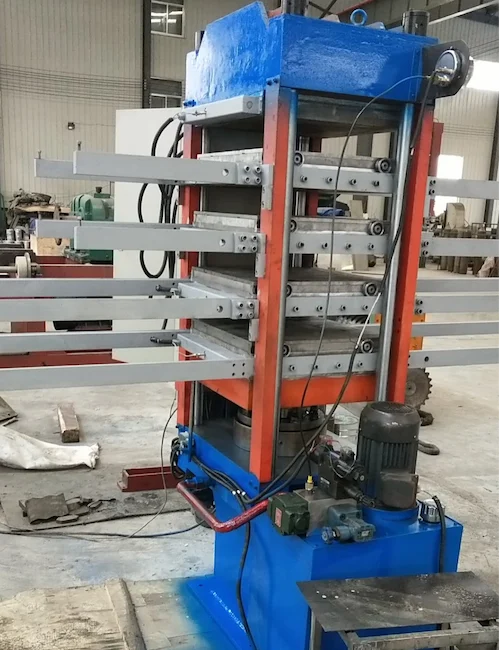
In this phase, an automatic rubber flooring tile vulcanizing machine is no longer introduced for speed alone, but for process control across growing production volumes.The need for automatic vulcanizing does not arise from a single factor. It emerges when multiple conditions converge. These conditions form a pattern that experienced manufacturers recognize almost immediately.
Automatic vulcanizing becomes necessary when:
Daily output exceeds the reliable capacity of manual systems, leading to frequent adjustments and rework
Product variations increase, such as different tile sizes, thicknesses, or formulations sharing the same line
Labor costs rise faster than output, reducing the economic advantage of manual handling
Quality disputes increase, especially with repeat customers or long-term projects
At this stage, automation is no longer a question of efficiency alone. It becomes a matter of operational stability. Automatic rubber flooring vulcanizing machines introduce synchronized control over heat, pressure, and time. This synchronization removes guesswork from the most critical stage of production.
More importantly, it creates predictability. Production planning becomes more accurate. Delivery commitments become easier to meet. The entire manufacturing rhythm stabilizes.
Manufacturers who delay automation beyond this point often find themselves trapped in reactive management, constantly adjusting schedules and staffing to address problems that originate in process design rather than effort.
How Production Changes After Automation
Introducing automatic vulcanizing reshapes the production line in ways that extend beyond the machine itself. The most visible change is output consistency, but deeper changes occur behind the scenes.
Workflow becomes more linear. Instead of juggling multiple manual tasks, operators oversee system performance and material flow. Decision-making shifts from moment-to-moment adjustments to process monitoring and optimization.
Labor allocation changes as well. Fewer operators are required per unit of output, but those operators engage with higher-level tasks. Training focuses on system understanding rather than manual repetition.
Automatic vulcanizing also improves coordination between upstream and downstream processes. Mixing, molding, vulcanizing, and finishing align more closely when cycle times are predictable. Bottlenecks become easier to identify and address.
These changes do not eliminate human involvement. They elevate it. Automation handles repetition and precision, while people manage quality oversight and continuous improvement.
Comparing Production Outcomes Before and After Automation
The impact of automatic vulcanizing becomes clearest when production outcomes are viewed side by side. Rather than focusing on machine specifications, comparing operational results highlights why automation changes decision-making.
| Production Aspect | Manual Vulcanizing | Automatic Vulcanizing |
|---|---|---|
| Output stability | Variable across shifts | Consistent across runs |
| Labor dependence | Elevado | Reduced |
| Cycle control | Operator-based | System-controlled |
| Quality variation | Batch-dependent | Predictable |
| Escalabilidade | Limited | Elevado |
These differences explain why the automatic rubber flooring tile vulcanizing machine has become standard equipment in scaled rubber flooring production lines.This comparison reflects daily operational reality rather than theoretical capability. Automatic vulcanizing reduces uncertainty, which is often the most expensive hidden cost in manufacturing.
Once uncertainty is reduced, manufacturers gain confidence to accept larger orders, standardize product lines, and pursue new markets.
Automation as a Strategic Production Decision
Automatic vulcanizing is often discussed as a machine upgrade, but its real impact is strategic. It defines how a rubber flooring manufacturer positions itself in the market.
Factories that rely on manual vulcanizing tend to compete on flexibility and short-term responsiveness. Factories that adopt automatic vulcanizing compete on reliability, scale, and long-term partnerships. Neither approach is inherently superior, but they serve different growth paths.
The moment rubber flooring production needs automatic vulcanizing is the moment growth demands structure. At that point, automation is no longer about replacing labor or increasing speed. It is about aligning production capability with market expectations.
Once production crosses this threshold, the question changes. It is no longer whether automation makes sense, but how long manual systems can continue to support expansion without limiting opportunity.
That realization marks the true beginning of modern rubber flooring manufacturing.